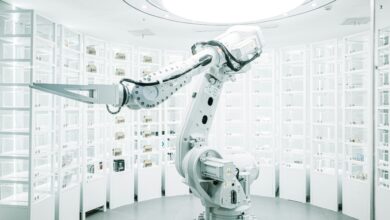
The rapid integration of automation into the global economy has sparked one of the most polarizing debates of the twenty-first century. As silicon and steel begin to replace muscle and even certain types of cognitive labor, society is forced to confront a fundamental question: Is the robotic workforce an engine of unparalleled efficiency, or does it represent an existential threat to human livelihood?
For decades, robotics was confined to the heavy lifting of automotive assembly lines—predictable machines performing repetitive tasks in caged environments. Today, however, the landscape has shifted. Advanced sensors, sophisticated artificial intelligence, and the advent of “cobots” (collaborative robots) have allowed machines to step out of the cages and into our warehouses, hospitals, kitchens, and offices. This evolution is driven by an insatiable corporate demand for productivity and the technological breakthrough of machine learning.
While proponents argue that automation will liberate humans from “dirty, dull, and dangerous” work, critics warn of a “useless class” of workers displaced by algorithms that don’t need sleep, benefits, or a paycheck. To navigate this complex transition, we must look beyond the binary of “good vs. evil” and analyze the multifaceted impact of robotics on the economy, the nature of work, and the social contract itself.
The Efficiency Catalyst: Why Industries are Automating
The primary driver behind the adoption of robotics is, and has always been, the pursuit of efficiency. In a globalized market where margins are razor-thin, the economic advantages of a robotic workforce are too significant for most large-scale enterprises to ignore.
A. Unmatched Consistency and Precision: Unlike human workers, robots do not suffer from fatigue, boredom, or emotional distraction. In precision manufacturing, such as semiconductor fabrication or medical device assembly, a robot can perform the same sub-millimeter movement millions of times with zero variance. This level of “Six Sigma” quality control reduces waste, lowers the cost of defects, and ensures a superior end product.
B. Operational Continuity and 24/7 Productivity: A robotic workforce operates on a “lights-out” manufacturing principle. A factory populated by autonomous systems does not require heating, air conditioning, or lighting in the same way human-centric facilities do. Furthermore, robots can work through the night, through holidays, and during global crises, such as pandemics, ensuring that supply chains remain resilient and uninterrupted.
C. Addressing the Global Labor Shortage: Many developed nations are currently facing a demographic crisis characterized by aging populations and a shrinking labor pool. In sectors like agriculture, construction, and long-haul trucking, there is a chronic shortage of workers willing to perform physically demanding labor. Robotics fills this void, allowing economies to maintain growth levels that would otherwise be impossible with human labor alone.
D. Enhanced Safety in Hazardous Environments: One of the most ethical arguments for robotics is the removal of humans from high-risk scenarios. Whether it is decommissioning nuclear power plants, diffusing explosive devices, or working in deep-sea mining, robots act as our proxies in environments that would be fatal or life-altering for biological organisms.
The Economic Friction: Is Job Displacement Inevitable?
Despite the clear benefits to the bottom line, the “threat” aspect of the robotic workforce centers on the displacement of human labor. History provides two conflicting views on this matter: the Luddite fear of total unemployment and the optimistic view that technology always creates more jobs than it destroys.
A. The Erosion of Middle-Skill Roles: Historically, automation targeted “low-skill” manual labor. However, with the rise of AI-driven robotics, “middle-skill” cognitive roles are now at risk. Data entry, basic accounting, legal document review, and even certain types of diagnostic medicine are being automated. This creates a “hollowed-out” labor market where wealth is concentrated at the top (owners of the robots) and the bottom (service jobs that are too dexterous or empathetic for current robots), while the middle class shrinks.
B. The Speed of Transition vs. Human Adaptability: The Industrial Revolution took nearly a century to unfold, giving generations time to adapt. The Robotic Revolution is happening in a matter of decades. The primary threat is not that jobs will vanish forever, but that the rate of displacement will far outpace the rate of retraining. A 50-year-old truck driver whose job is replaced by an autonomous fleet cannot easily “pivot” to becoming a software engineer or a robotics technician.
C. Wage Stagnation and the Decoupling of Productivity: Economists have observed a concerning trend where productivity continues to rise due to automation, but wages for the average worker remain stagnant. When a robot does the work, the profits go to the shareholders and the owners of the capital, rather than being distributed as wages. This decoupling risks creating a society with extreme wealth inequality, where the benefits of technological progress are not shared by the majority.
The Collaborative Future: The Rise of Cobots

Mastering the transition to a robotic workforce may lie in the concept of “Collaborative Robotics” or Cobots. Unlike traditional industrial robots that operate in isolation, cobots are designed to work alongside humans, augmenting their capabilities rather than replacing them entirely.
A. Human Intuition Meets Robotic Power: In a collaborative environment, the robot handles the heavy lifting, repetitive sorting, and high-speed data processing. The human worker provides the high-level decision-making, creative problem-solving, and emotional intelligence that machines still lack. This “augmented” workforce is often more productive than a purely human or purely robotic one.
B. Customization and Flexibility: Cobots are typically smaller, more portable, and easier to program than their industrial ancestors. This allows small-to-medium enterprises (SMEs) to adopt automation. A human worker can “train” a cobot by physically moving its arm through a task, effectively turning the robot into a high-tech power tool rather than a replacement worker.
C. The Human Touch in Service Robotics: In the healthcare and hospitality sectors, the “efficiency vs. threat” debate is settled by the necessity of human interaction. A robot can deliver medication to a hospital room with 100% accuracy (efficiency), but it cannot provide the empathy and comfort required by a patient (human value). In these fields, robots serve as assistants, handling the logistics so that humans can focus on the “human” parts of their jobs.
The Social Contract: Preparing for a Post-Work World
If the robotic workforce eventually reaches a point where it can perform the majority of human tasks, society will need to redefine the relationship between work, income, and dignity. This shift requires bold policy interventions and a rethinking of our educational systems.
A. The Lifelong Learning Mandate: The traditional model of “learn for twenty years, work for forty” is dead. In a robotic economy, skills become obsolete every five to ten years. Educational systems must transition to a model of continuous, lifelong learning. Governments and corporations must provide “reskilling accounts” or subsidies that allow workers to constantly update their technical literacy.
B. Universal Basic Income (UBI) and Robot Taxes: As automation reduces the total number of hours worked by humans, the idea of Universal Basic Income has moved from the fringes of academia to serious political debate. Proponents argue that if robots generate the wealth, that wealth should provide a floor for all citizens. Some economists propose a “Robot Tax,” where companies pay a social security-style tax for every human worker they replace with a machine, funding the transition of the displaced workforce.
C. Redefining Meaning and Purpose: In Western society, identity is often tied to one’s profession. If a robotic workforce takes over traditional labor, we must find new ways to define human value. This could involve a resurgence in the arts, community service, caregiving, and environmental restoration—sectors where human presence is inherently valuable.
Sector-Specific Impact: Where the Change is Happening Now

The robotic workforce is not a monolith; it is manifesting differently across various industries. Understanding these nuances is key to identifying where the efficiency is greatest and the threat is most acute.
A. Logistics and Warehousing: Companies like Amazon and Ocado have pioneered the use of autonomous mobile robots (AMRs) to sort and move inventory. Efficiency has increased by over 300% in some facilities. The threat here is concentrated on entry-level labor, but the demand for “robot technicians” to maintain these fleets is exploding.
B. Agriculture: From autonomous tractors to fruit-picking drones, robotics is solving the “seasonal labor” problem. Efficiency is seen in the reduction of pesticide use (through targeted robotic application) and higher crop yields. The threat is to migrant labor populations who rely on these seasonal roles for survival.
C. Construction: 3D-printing robots can now “print” the shell of a house in 24 hours. Robotic bricklayers work three times faster than humans. While this could solve the global housing crisis (efficiency), it puts traditional trades—masons, carpenters, and laborers—at significant risk of displacement.
D. The Culinary Arts: Automated kitchens are now capable of preparing complex meals, from burgers to sushi, with perfect consistency. In fast-food environments, where turnover is high and margins are low, the efficiency gain is undeniable. However, the loss of the “chef’s touch” and the elimination of thousands of first-time jobs for young people remain a major social concern.
Shaping the Silicon Future
The transition to a robotic workforce is not a force of nature that we must passively accept; it is a choice that we must actively manage. Robotics offers a path to a world of abundance, where poverty is eradicated and the human spirit is freed from drudgery. However, that same path is fraught with the risk of social fragmentation and economic exclusion.
The “efficiency” of robots is a tool. Like any tool, its impact depends on the hands that hold it. To ensure that the robotic workforce is a benefit rather than a threat, we must prioritize:
- Human-centric design that focuses on augmentation rather than total replacement.
- Proactive legislation that protects displaced workers and redistributes the gains of automation.
- A global dialogue on the ethics of AI and the preservation of human dignity in a digital age.
We are standing at the threshold of a new era. The robots are here, and they are staying. Our task is not to stop the machines, but to ensure that they work for us, rather than against us. By mastering the integration of these silicon workers today, we can build a future where technology and humanity thrive in a sustainable, efficient, and equitable partnership.